
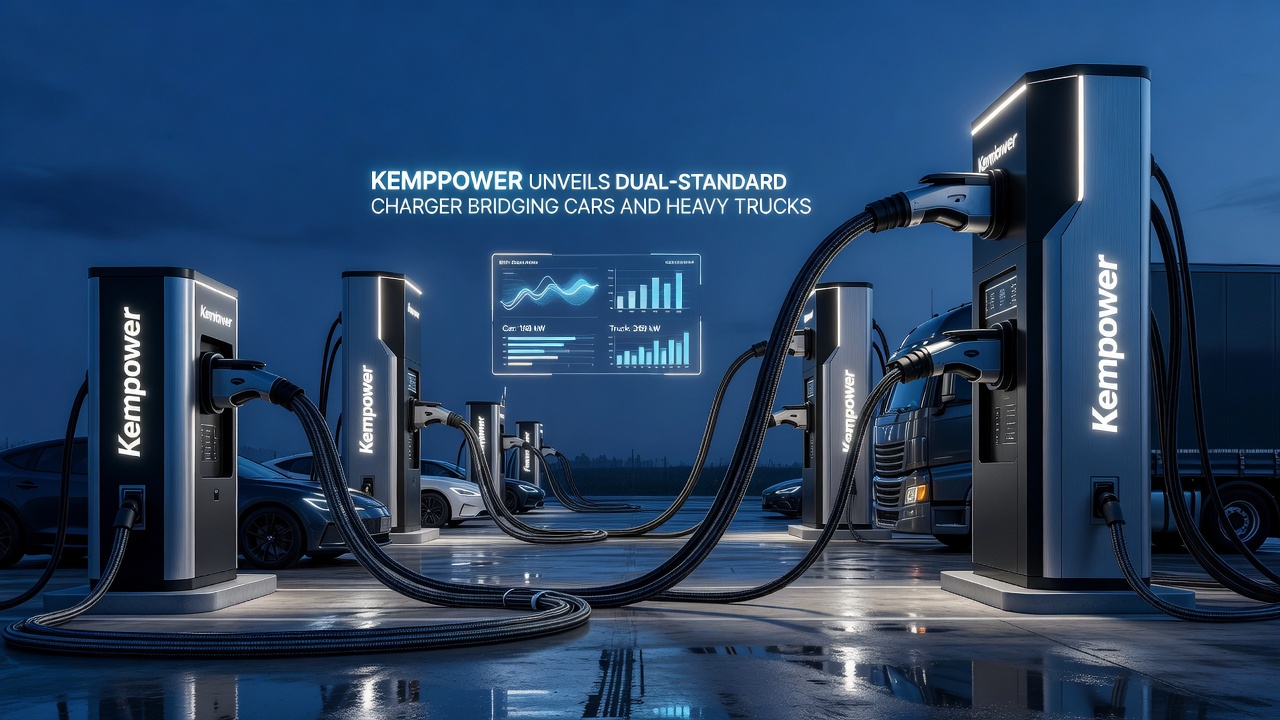
Kempower has introduced a charging dispenser designed to serve both passenger electric vehicles and heavy-duty trucks from a single unit, a move that addresses one of the thorniest infrastructure questions facing the electrification of freight transport. The new Mega Satellite Flex supports the established Combined Charging System, or CCS, at up to 560 kW, alongside the emerging Megawatt Charging System, or MCS, at up to 1.2 MW. It is the Finnish manufacturer's first product to offer both standards in one dispenser.
The timing reflects a broader industry reality: charging infrastructure is being built for two very different vehicle populations at once. Passenger EVs overwhelmingly rely on CCS, a standard that has matured over more than a decade, while electric trucks require far greater power delivery to make long-haul routes commercially viable, which is why MCS was developed specifically for that purpose. Rather than forcing site operators to choose one standard or build separate installations later, Kempower's approach lets a single location serve both from day one. That kind of flexibility matters increasingly to consumers too, in the same way that people researching topics like paying for a VPN anonymously are looking for solutions that reduce friction and future-proof their choices rather than lock them into a single path.
Why Combining Standards Matters
Building charging infrastructure is capital-intensive, and land, grid connections, and permitting are often the binding constraints, not the hardware itself. A charging site that can only serve one vehicle category risks sitting underused during certain hours or missing an entire class of customers altogether. By supporting both CCS and MCS, and by handling up to 700 amps on the car-charging side and 1,500 amps for trucks, the Mega Satellite Flex allows operators to serve commuter EVs during the day and long-haul trucks overnight, or any mix in between, without a second construction project. The unit also supports newer 800-volt vehicle architectures, which are becoming more common among premium and performance EVs seeking shorter charging stops.
Practical Details for Operators
Kempower has kept the physical design pragmatic. The CCS cable runs 5 meters, long enough to comfortably reach a range of vehicle port positions, while the MCS cable measures 2.7 meters, reflecting the more standardized dock positioning expected on heavy trucks. An optional payment terminal can be integrated directly into the unit, which matters for public-facing sites where card or contactless payment is expected rather than app-based billing alone. Because the dispenser is compatible with Kempower's existing distributed charging architecture, operators already running Kempower systems can add the Mega Satellite Flex without replacing power cabinets or rethinking site layout entirely.
What Comes Next
The charger was shown publicly at Kempower's Unplug & Recharge event held alongside ACT Expo, a gathering focused on commercial and heavy-duty vehicle technology. Kempower has set a North American and European launch for July 2026, giving fleet operators and charging network developers over a year to plan sites around the new hardware. The broader significance lies less in the specifications than in the strategic bet: as MCS infrastructure slowly comes online globally, dispensers that hedge between today's dominant standard and tomorrow's heavy-duty requirement may determine which charging networks scale efficiently and which face costly retrofits.