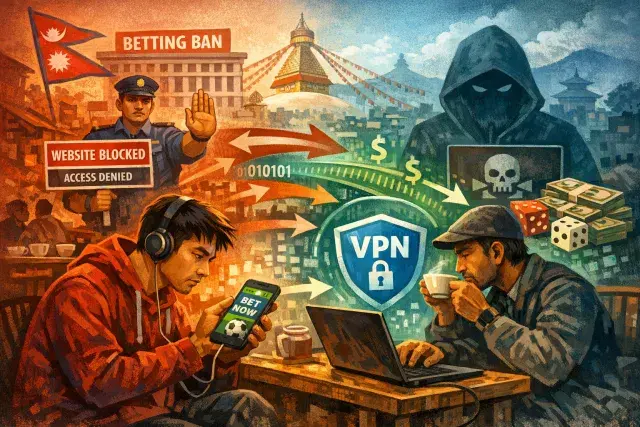

Nepal has blocked more than 10,000 betting sites in a rapid enforcement drive, yet the ban is proving porous. In tea shops and homes around Kathmandu Valley, some users have already turned to VPNs and redirected links to keep gambling online despite the government’s shutdown order.
The episode captures a familiar problem in digital regulation: blocking websites is fast, but changing user behavior and cutting off workarounds is far harder. In Nepal’s case, the challenge sits at the intersection of law enforcement, telecom oversight, platform advertising, and public awareness.
A fast crackdown with clear legal backing
The shutdown followed a Cabinet decision in late March 2026 that placed the Ministry of Communications and Information Technology under pressure to act within 24 hours. The Nepal Telecommunications Authority then coordinated with internet service providers to identify and block betting apps and websites, while also responding to complaints from the public.
Officials say domestically operated sites have been shut down and foreign-operated services restricted inside Nepal. The legal basis is straightforward. Nepal’s National Penal Code prohibits engaging in or facilitating betting, with penalties including imprisonment, fines, and confiscation of property used in the offense. The Advertisement (Regulation) Act also bars ads that encourage gambling or promote unauthorized lottery activity.
That matters because online betting is not only a question of individual choice. It involves payment channels, ad networks, referral links, mirror sites, and social sharing. A ban can remove visible access points quickly, but the wider ecosystem often adapts just as quickly.
Why blocking websites does not end access
Officials acknowledge the central weakness: VPNs are difficult to block because they are not illegal tools in themselves. A VPN can mask a user’s location and route traffic through other jurisdictions, making a blocked service appear reachable again. That does not legalize the underlying gambling activity, but it complicates enforcement.
The problem extends beyond VPNs. Betting operators often rely on replacement domains, cloned pages, and ads placed through third-party systems. A legitimate app or website may carry an advertisement that redirects users elsewhere when clicked. That creates a moving target for regulators, especially when the original service is hosted abroad and can reopen under a new address within hours.
This is why raw blocking numbers, while significant, do not tell the whole story. A site ban can reduce casual access and disrupt operators, but it rarely eliminates demand on its own. Users who are determined, socially encouraged, or already financially involved often look for alternate routes.
The cyber risks of “free” workarounds
That shift carries a second danger beyond gambling itself. As IT expert Rajib Subba warns, many users rely on free VPN services, which can expose them to malware, ransomware, data theft, and privacy breaches. Free tools are attractive because they remove cost and friction, but they may also collect user data or deliver malicious software onto the device.
For people chasing quick returns through illegal betting apps, this creates a layered risk. They may lose money to the gambling platform, lose control of personal data through the VPN or redirect links, and expose phones or computers to wider compromise. If digital wallets, contact lists, photos, banking apps, or work accounts are stored on the same device, the fallout can stretch well beyond a single bet.
What the government can and cannot do next
The government can keep tightening technical blocks, pressuring intermediaries, and investigating operators and promoters. It can also work with payment services, advertising channels, and telecom providers to make access less convenient. But officials are right to recognize a limit: they cannot lawfully inspect every citizen’s device in the name of enforcement.
That leaves public behavior as the harder frontier. If users see betting as easy money, shutdowns will remain incomplete. More durable progress will depend on repeated public education about the legal consequences, the financial harms of online gambling, and the cybersecurity risks of the tools people are now using to bypass the ban. Nepal’s crackdown has made betting less visible. It has not yet made it disappear.